A Philosophy Atlas
Where ideas traveled
From Miletus to Paris, from the Stoa to the Enlightenment: explore philosophy as a living atlas of people, schools, virtues, and ideas across the world.
Ten volumes
Each one a world of its own. Run along the shelf to preview a volume, then step into it.
Select a volume to preview
Ways in
Read, map, compare, or simply wander.
The shelf is the front door. These paths turn each volume into journeys, maps, daily readings, timelines, and influence trails.
See the whole arc
Place thinkers in time, then follow how ideas passed from mind to mind.
From the archive
The road up and the road down are one and the same.
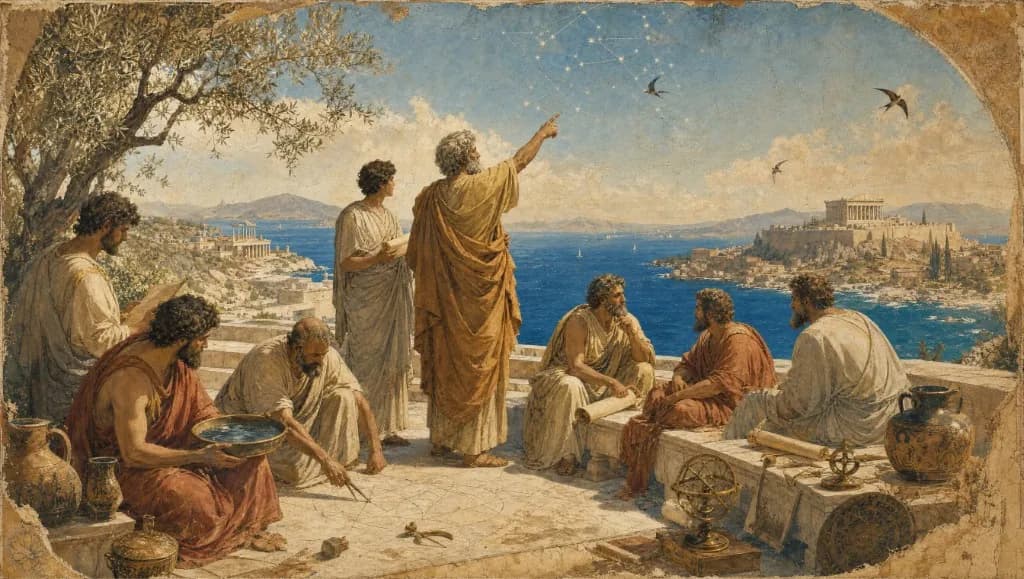
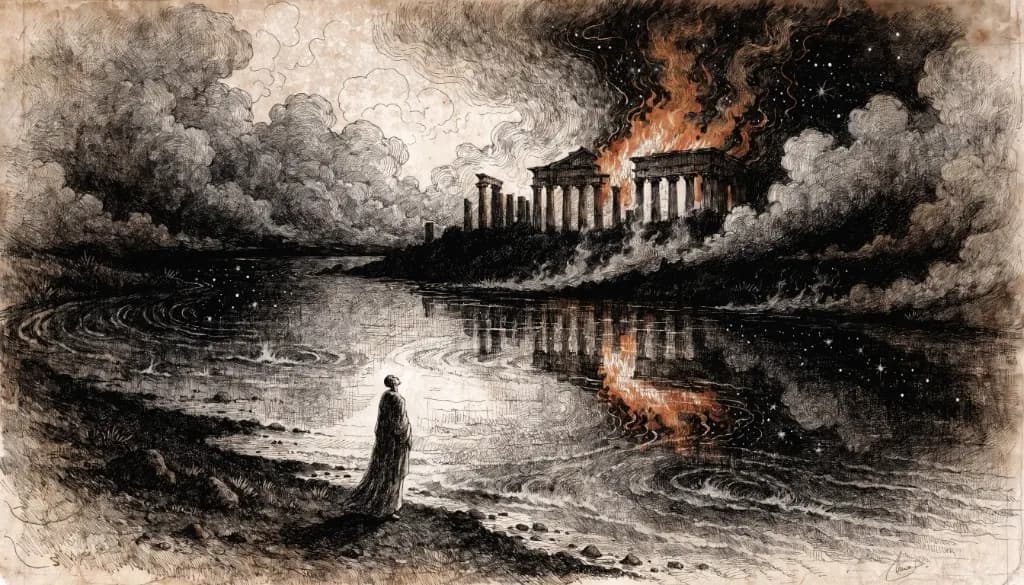
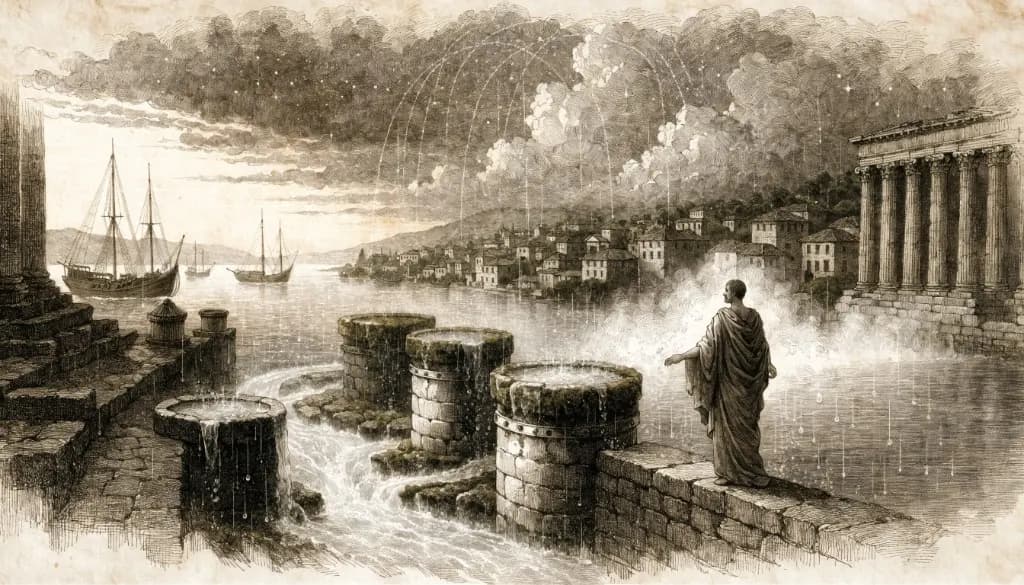
Philosophy began as a disagreement. Thales looked at a river and argued the world was water. Anaximenes said air. Heraclitus corrected both of them and said fire. Parmenides said all three were wrong because change was an illusion to start with. Four people, one small city on the coast of what is now Turkey, and two generations of productive argument. That is where this atlas starts.
Atlas of Thinkers is a map of 3,000 years of that argument. It places 210 philosophers in the cities where they worked, the schools they came from, and the debates they were trying to answer. Place matters here as much as thought. The ideas of Stoicism look different once you know they were first taught in a painted porch in Athens, then carried to Rome by a Cypriot merchant who had just lost his cargo at sea. Ideas travel with people. The map shows where they went.
Ten volumes, five continents
The atlas covers ten traditions. Volume I traces ancient Greek philosophy from the Milesian cosmologists of the sixth century BCE to the Epicureans and Skeptics of the third. Volume II follows the Stoic tradition into Rome through Cicero, Seneca, and Marcus Aurelius. Volume III turns to classical Chinese philosophy and the Hundred Schools period that produced Confucianism, Taoism, and Legalism. Volume IV covers the Islamic Golden Age, when Avicenna was building a new synthesis of Aristotle and medicine in Persia while Averroes was writing his commentaries in Cordoba. Volume V reaches into classical Indian philosophy and the Buddhist and Hindu traditions that shaped a civilization across fifteen centuries. Volume VI covers medieval Europe and the long effort to reconcile Greek logic with Christian theology. Volumes VII and VIII cover early modern thought and the Enlightenment, the two centuries that produced Descartes, Locke, Hume, and Kant. Volumes IX and X bring the story into modern and contemporary philosophy, from Hegel and Nietzsche through Simone de Beauvoir, Frantz Fanon, and Steve Biko.
Each volume is self-contained. You can start anywhere.
The same questions, different centuries
The central philosophical questions do not change much across those ten traditions. What is the right way to live? What do we owe each other? What can we actually know, and how do we know it? What makes an action right or wrong?
The history of ethics runs from Socrates asking what virtue requires of a person, through Kant arguing that the moral worth of an action depends on the intention behind it, to contemporary political philosophy asking what a just society looks like when you take seriously the claims of everyone in it. Human existence looks different from Athens in 400 BCE, from Song Dynasty China, from colonial South Africa in 1970. But the underlying question is the same: how should a person live, given what the world is?
What changes across the volumes is vocabulary, method, and stakes. Ancient philosophers worked through dialogue. Medieval ones worked through commentary on received texts. Enlightenment thinkers wrote treatises aimed at people who had never studied philosophy before. Contemporary philosophers write papers with numbered footnotes. The form shapes the argument, but the argument returns to the same ground. Understanding how those forms evolved is part of what the atlas is for.
How the atlas works
Each philosopher has a profile covering their life, their primary ideas, their key works, and the relationships that shaped their thinking. Journey mode is a short narrative account of a philosopher's life told in chapters, with maps and key moments built in. The timeline puts every figure on a single axis so you can see who was alive alongside whom, and which intellectual traditions were running in parallel. The influence graph shows how ideas moved from one mind to another across centuries.
This atlas covers 210 thinkers. That is a small fraction of everyone who deserves to be here. For deeper reading, the Stanford Encyclopedia of Philosophy is the most thorough academic reference for any figure or concept you find here. For primary texts, Project Gutenberg has the complete works of most pre-twentieth-century philosophers in translation, free to read. Start anywhere. The map shows where everything connects.
Monthly Letter
Letters from the Atlas
Each month: one thinker, one idea, one virtue, and the latest from the Reading Room. Calm, brief, worth it.
No spam. Unsubscribe any time.